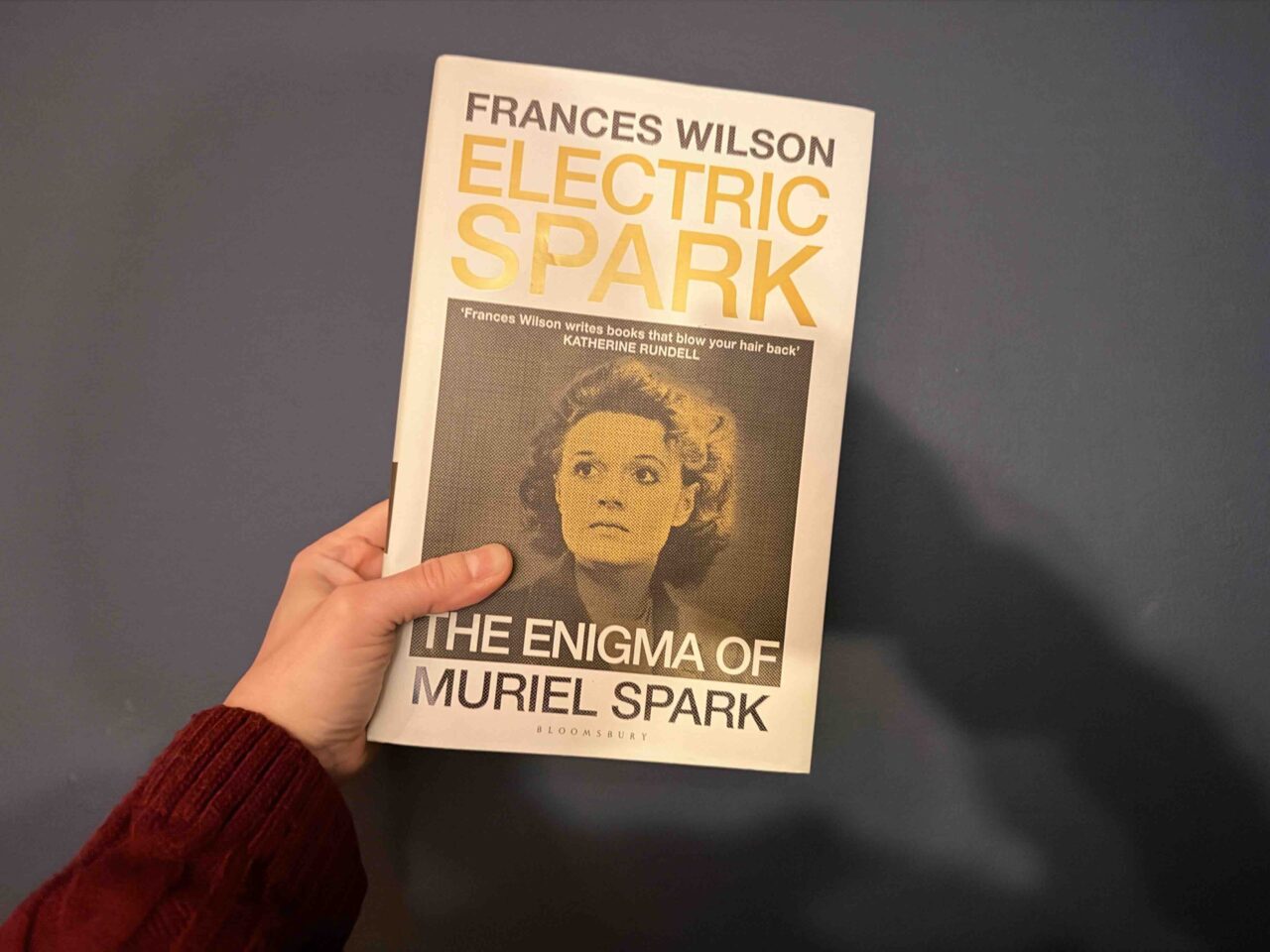
Electric Spark: The Enigma of Muriel Spark by Frances Wilson *****
Reading dates: 18 July 2025 – 15 March 2026
Electric Spark is so much more than a biography of Muriel Spark. It is structured, narrated and written with a flair than can only be Sparkian. It looks at coincidences, patterns and their beauties. I read it as my breakfast book, in short bursts with my second coffee, savouring each paragraph and allowing it to start my day inspired.
I love Spark’s life story. I enjoyed Martin Stannard’s biography too, but that was more pedestrian, more academic, without the understanding of the person Frances Wilson has. Although I also seem to have given Stannard 5 stars back in 2012 … And The Driver’s Seat (Spark’s favourite novel of hers and ‘a wicked little book’ as referred to by the impeccable artist and writer Sharon Kivland) only 4. It is a 5.
13 April 2026 marks the 20th anniversary of her death. I was already in Scotland, but I did not know her. In those days, sleep was elusive and I used to doze off listening to Book of the Week. Shortly after her death, they read The Finishing School, and I remember thinking, half-dreaming, what a curious novel it was. I ended up giving it 3 stars when I read it; I am too harsh a critic.
I don’t like biographies, as a genre, and from reading this book, I don’t think Spark did either, even though she was a biographer herself (of the Brontë sisters and Mary Shelley among others). Yet, Wilson problematises what she is doing so beautifully, I may need to add it to the list of things I need top revise. This year, another biography will be published: Like a Cat Likes a Bird: the Nine Lives of Muriel Spark by James Bailey. Needless to say, I will get it, will read it, will write about it. But I am already sure it will not compete with Wilson’t masterful account.
By now he had become what Spark describes as a borderline case, ‘and I didn’t like what I found on either side of the border.’, She learned about the dangers of compassion, she said, from Stefan Zweig’s Beware of Pity, the last novel he wrote before his suicide in 1942.
The story of a cavalry officer caving in to a crippled woman’s demands for love, Beware of Pity is the first sustained fictional account of emotional blackmail. There is nothing worse, Zweig writes, than being loved against your will and ‘unable to defend yourself against the passion thrust upon you’.
_____
There were other reasons for Muriel to be depressed: her husband had lost his mind, her marriage was over, her future as a mother was uncertain, the world was at war, and she was as trapped inside the Colony as Robinson Crusoe on his island.
_____
She was twenty-six when she left; the seventy-four-year-old author of Curriculum Vitae had long absorbed T. S. Eliot’s observation that an important function of intelligence was the discernment of exactly what, and how much, we feel in any given situation’.
_____
The Ingutsheni had been, until 1933, the Ingutsheni Lunatic Asylum for the dangerously insane’. In its new form it presented itself as an enlightened institution that reflected colonial ideology; black, white and
‘coloured’ patients were all admitted but in strictly segregated wards; doctors, rather than administering punishments, looked for ‘cures’; and electrical convulsant therapy was widely used.
The sign of a black or ‘coloured’ patient’s recovery was his or her renewed acceptance of white supremacy, and the sign of a white woman’s recovery was a healthy concern with her appear-ance. Ossie, in and out of hospitals all his life, never did recover.
His symptoms, after treatment, were not mania but lethargy; he spoke only about himself, stayed in bed all day, found standing up difficult and refused to eat, shave or change his pyjamas.
“You tell me to “snap out of it”, he wrote to Muriel in 1944,
“but I’m damned if I can. Ossie’s problem, she believed, was self-absorption. ‘Some people simply cannot help themselves by thinking of others, it is perhaps unkind to expect it.’
_____
She went into the Observer competition, she said in a letter to the Inland Revenue about whether or not the prize money was tax-able, as ‘one might enter for a crossword puzzle’. The germs of her vision can be found in the joint editorial to Forum: ‘We desire to balance the imaginative and the logical’, ‘the fantastic and the factual’, ‘the vivid romantic image’ with ‘the classical appearance of order’. ‘The Seraph and the Zambezi’ balances the Romantic, in the form of Baudelaire’s Cramer, ‘half poet, half dancer’, with the Classical, in the form of the Seraph, the highest order of angels. But there is no name for Spark’s style, where the natural and supernatural coexist like man and dog, other than Sparkian.